Best Level 2 EV Home Chargers (2026 Buyer’s Guide)
Choosing the best Level 2 EV home charger can dramatically reduce charging time, lower long-term energy costs, and increase the convenience of owning an electric vehicle. With so many options available — from high-power 64A chargers to smart Wi-Fi models — selecting the right one depends on your car, electrical setup, and daily driving needs.
In this guide, we analyzed the most powerful, reliable, and best-selling Level 2 EV chargers available today, focusing on performance, safety certifications, smart features, real-world reviews, and overall value for money.
Below, you’ll find a curated comparison of the top 5 Level 2 EV chargers, including:
- Best Overall EV Charger — the most balanced choice for most users
- Best for Tesla Owners — optimized for Tesla vehicles and adapters
- Best High-Power Charger (48A–64A) — maximum speed and future-proofing
- Best Value for Money — great performance at a lower price
- Best Smart EV Charger — Wi-Fi, app control, and energy monitoring
Whether you drive a Tesla, Ford, Rivian, Chevrolet, or any other electric vehicle, this comparison will help you choose the right Level 2 charger for your home with confidence.
Top 5 Best Level 2 EV Home Chargers (2026)
Top 5 Level 2 EV Home Chargers (2026 Picks)
Quick comparison first (for fast clicks). Then read the detailed reviews below.
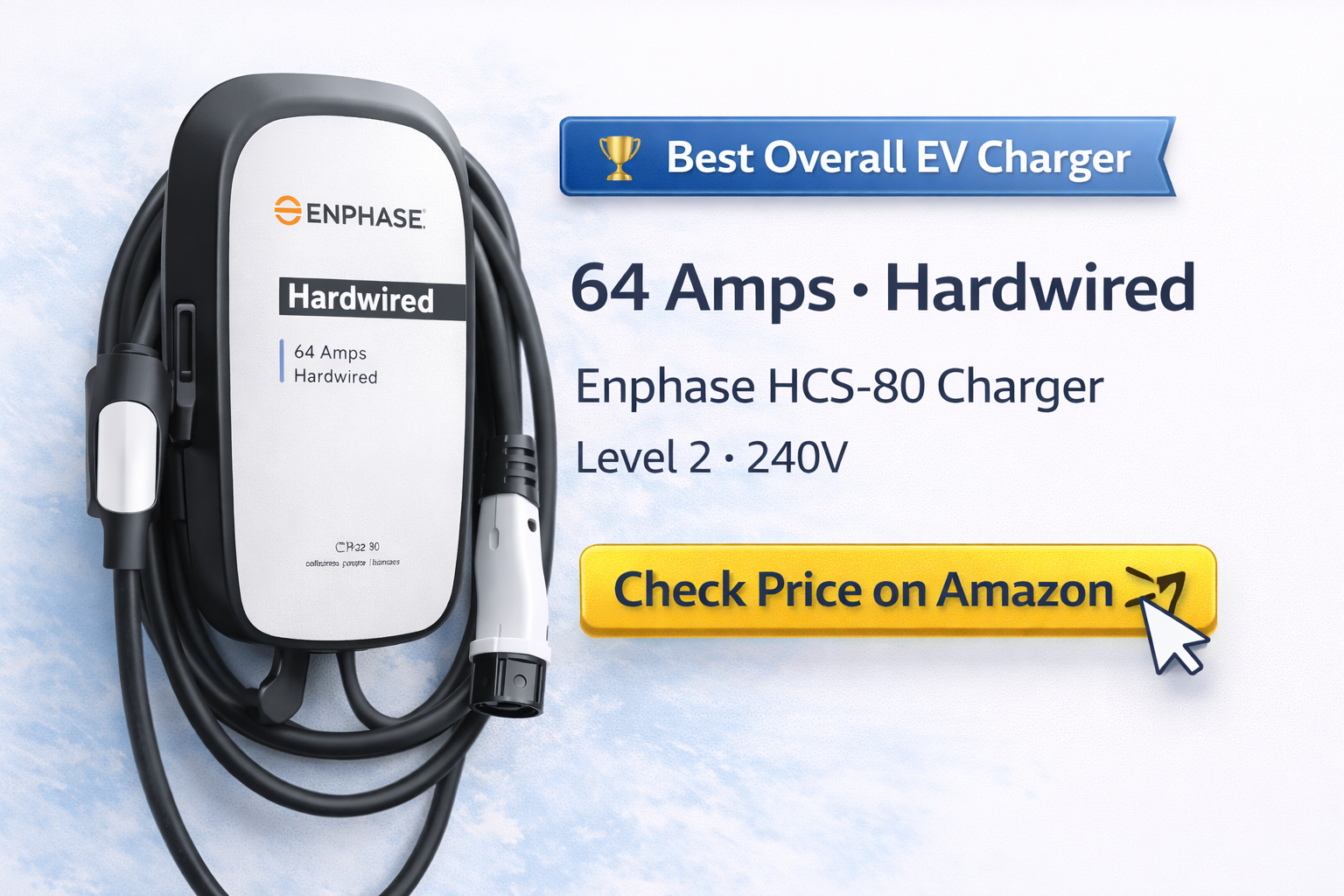
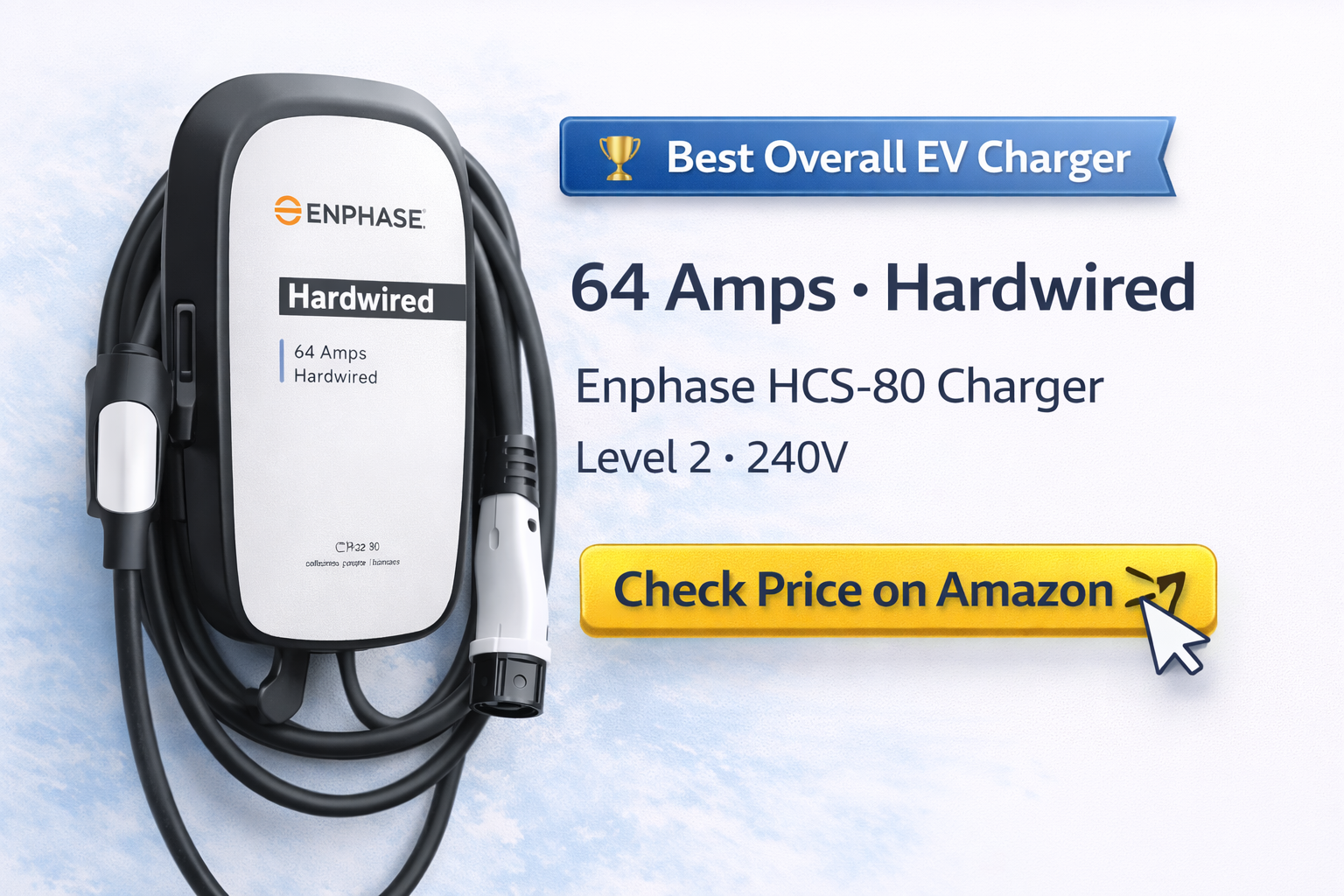
Enphase HCS-80 (Formerly ClipperCreek) – 64A Hardwired Level 2
Commercial-grade durability, safety-certified, and built for high-power overnight charging.
- 64A hardwired (240V) high-power home charging
- ETL / UL 2594 safety certified + ENERGY STAR
- 25 ft cable with rugged J1772 connector
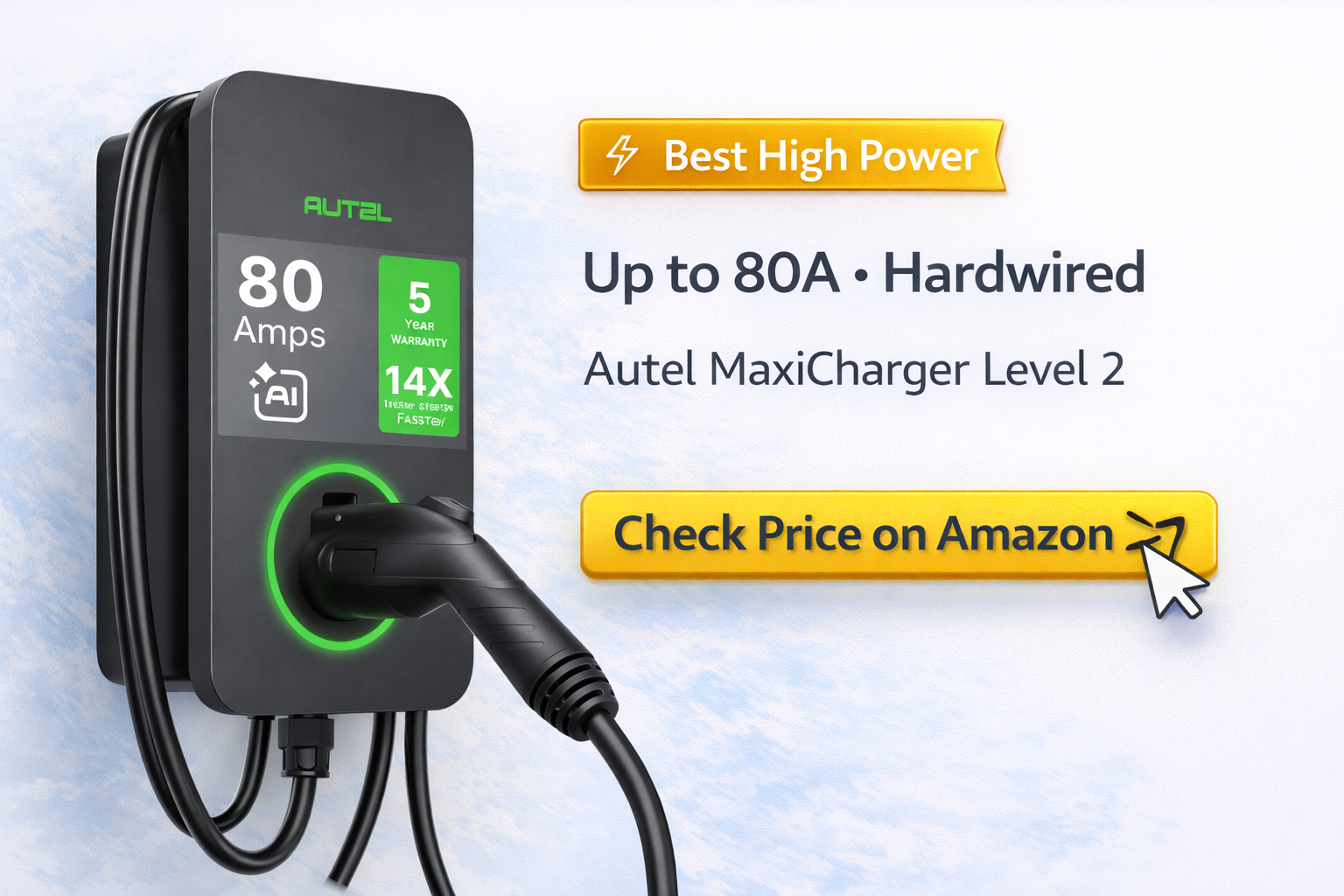
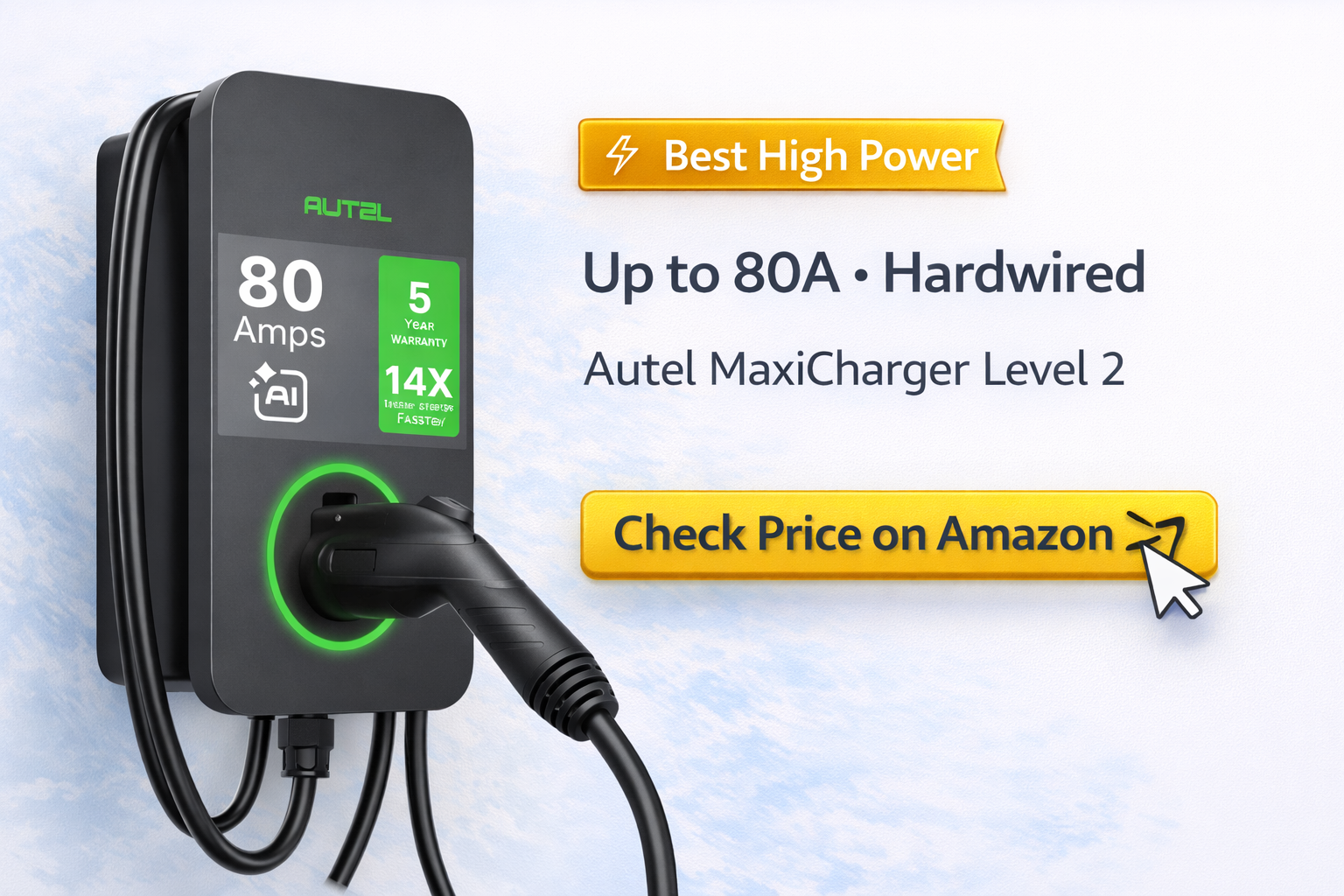
Autel MaxiCharger 80A – Level 2 (Hardwired)
High-power 80A output with smart app controls and robust reliability features.
- Up to 80A / 19.2 kW (future-proof for large-battery EVs)
- Smart scheduling, energy monitoring, alerts
- 25 ft J1772 cable (Tesla compatible with adapter)
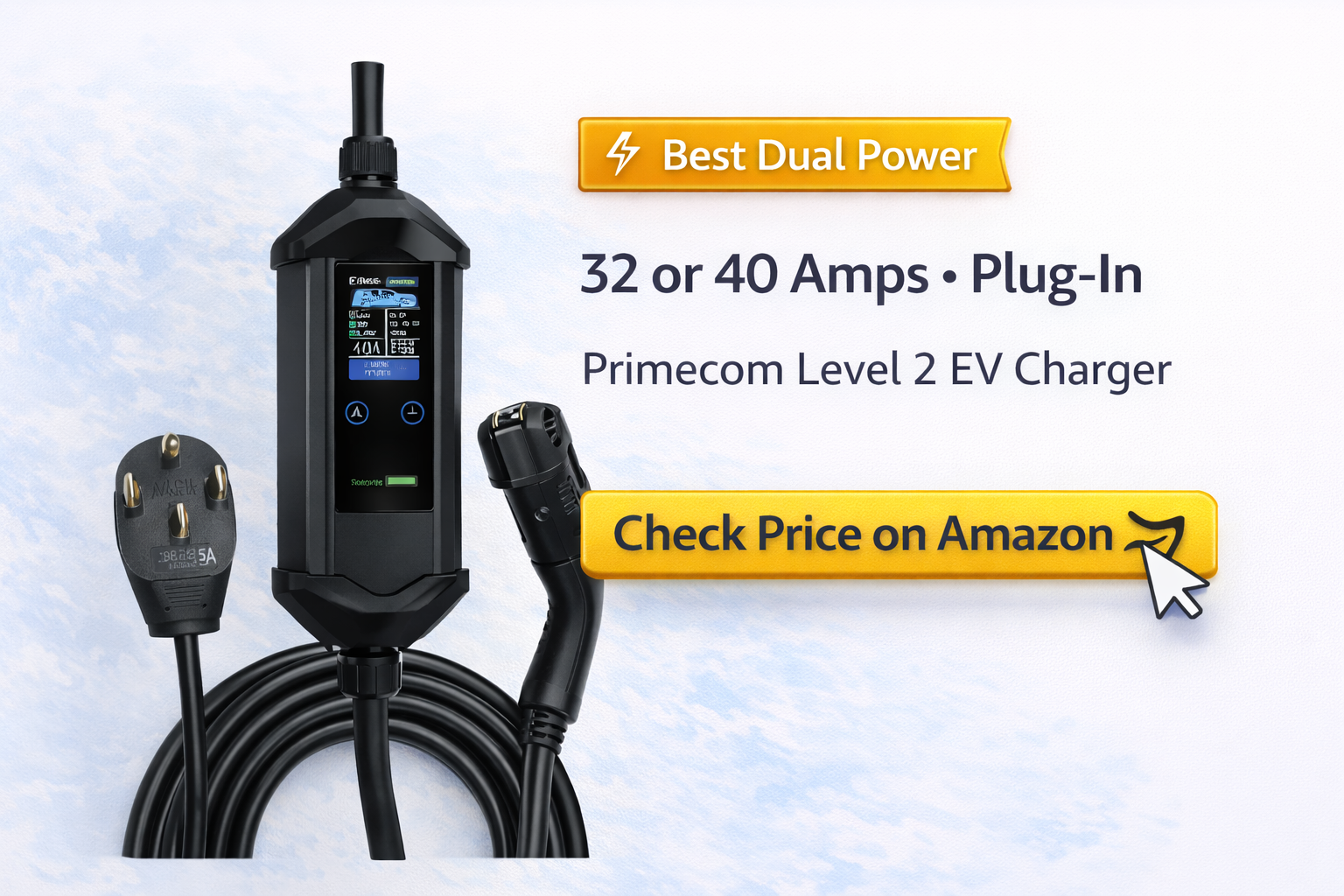
Primecom Level 2 EV Charger – 32A / 40A (NEMA 14-50 Plug-in)
Great budget-friendly pick with plug-in convenience and multiple cable length options.
- Plug-in NEMA 14-50 (easy setup for many garages)
- Choose 32A or 40A depending on your needs
- Solid pick for most daily commutes
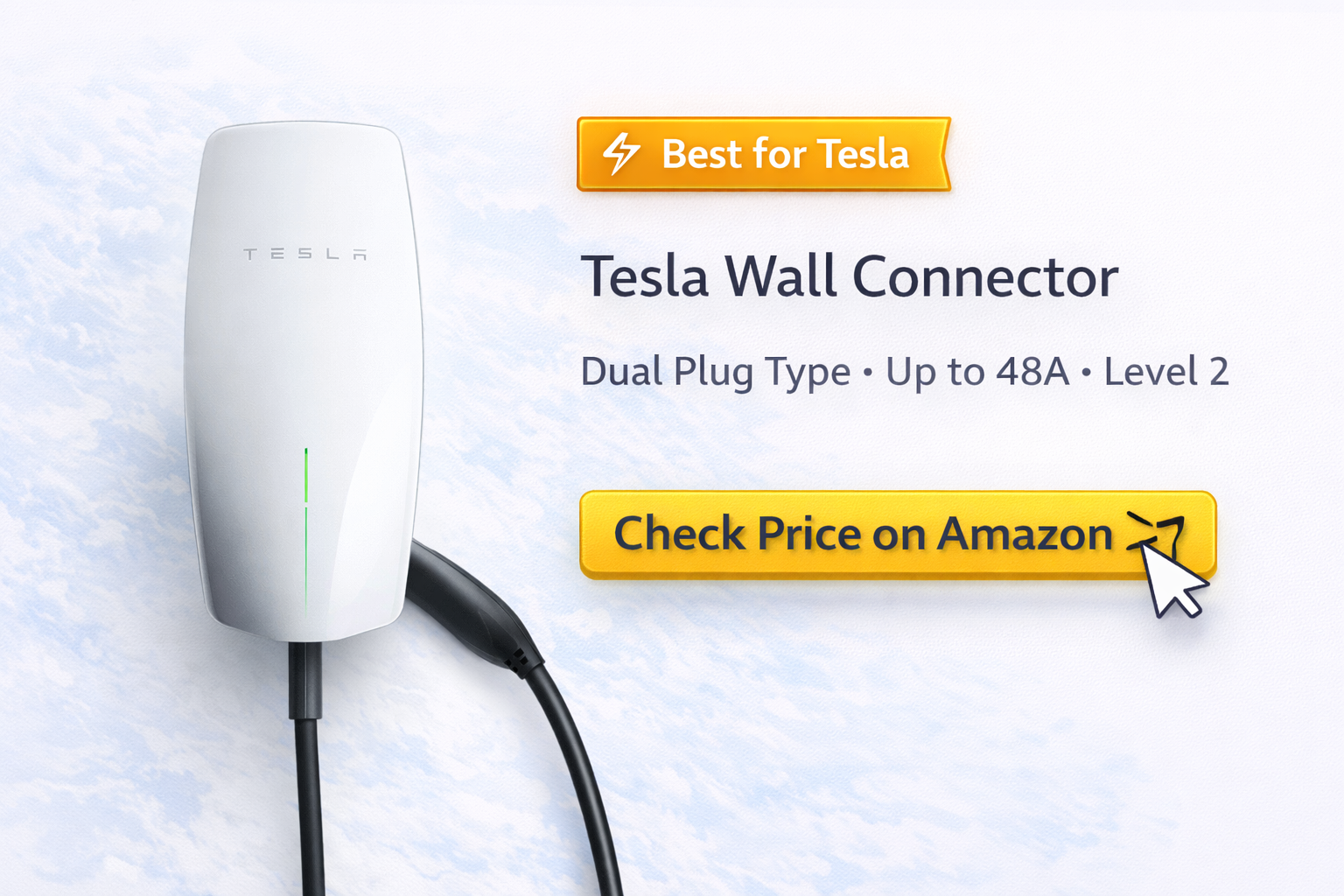
Tesla Universal Wall Connector – Level 2 (Up to 48A)
Best pick for Tesla owners who want a clean wall mount and strong ecosystem support.
- Designed for Tesla home charging setups
- Fast Level 2 performance (depends on circuit)
- Premium wall-mounted look
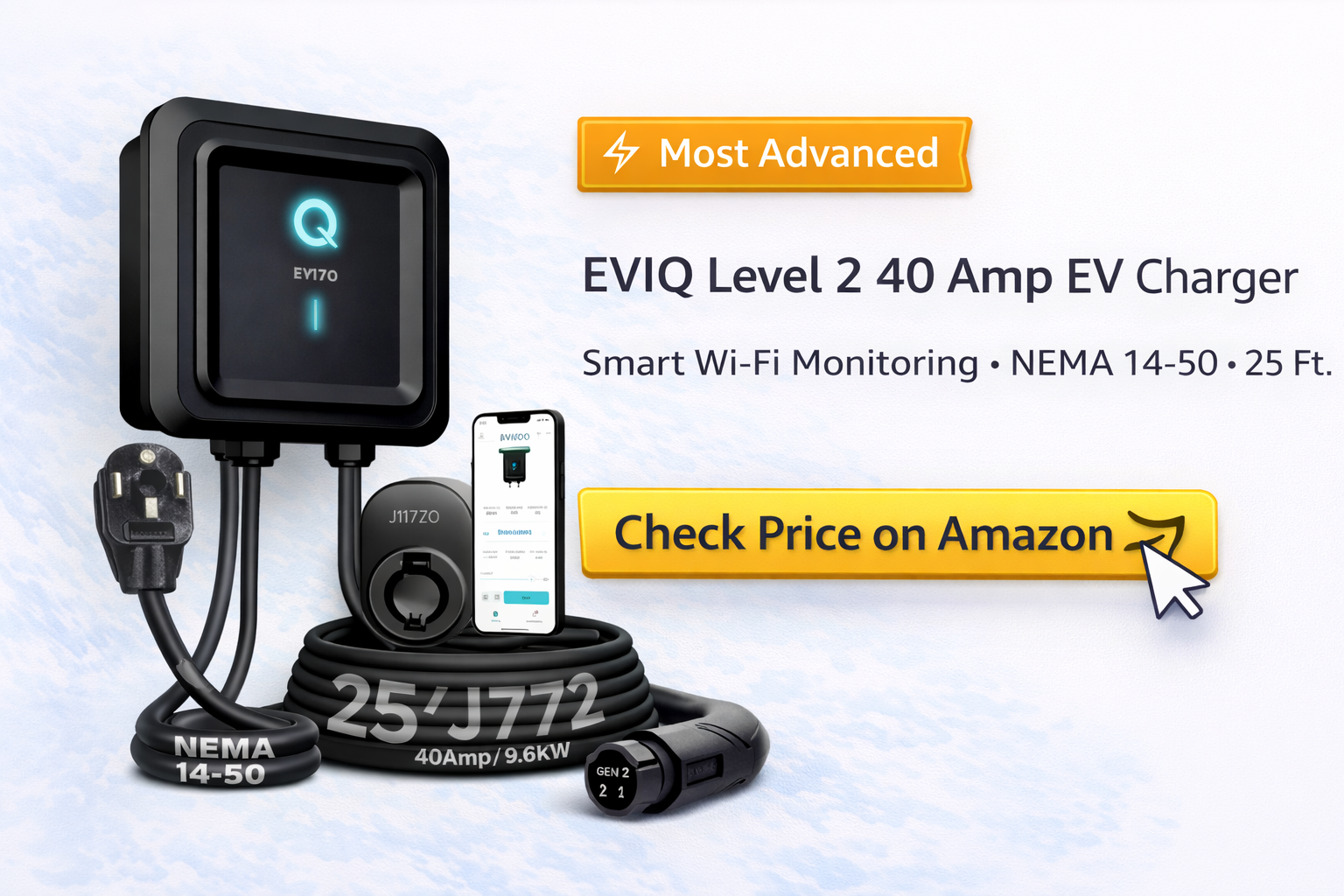
EVIQO Level 2 Smart EV Charger – 40A (Plug-in)
Wi-Fi + app controls at a great price, ideal for most home charging routines.
- 40A / 9.6 kW fast home charging
- Smart scheduling + remote start/stop
- NEMA 14-50 plug + 25 ft J1772 cable
Enphase HCS-80 (Formerly ClipperCreek) — 64A Level 2 EV Home Charger
If you want maximum charging speed and a truly pro-grade build, the Enphase HCS-80 is one of the strongest hardwired Level 2 chargers you can buy for home use.
- Best for high-power setups: great for drivers who want the fastest home charging possible.
- Professional-grade durability: built for reliability and long-term daily use.
- Hardwired installation: cleaner look and typically better stability than plug-in units.
- Ideal for larger batteries: a strong match for EV owners who charge frequently or drive more miles.
Disclosure: As an Amazon Associate, I earn from qualifying purchases. Price and availability may change.
Enphase HCS-80 (Formerly ClipperCreek) — 64A Level 2 EV Charger (Hardwired)
The Enphase HCS-80 is a professional-grade Level 2 home EV charger built for maximum speed, durability, and all-weather reliability. It delivers up to 15.4 kW on a dedicated 80A circuit, making it a strong choice for drivers who want the fastest possible overnight charging.
| Brand | Enphase Energy |
|---|---|
| Color | Black |
| Output Voltage | 240V |
| Max Power | Up to 15.4 kW (64A) |
| Certifications | ETL (UL 2594) + ENERGY STAR |
| Cable & Connector | 25 ft cable, J1772 ruggedized connector |
| Outdoor Rating | NEMA 4 sealed enclosure |
| Installation | Hardwired (requires dedicated 80A circuit) |
| Warranty | 5-year limited warranty + customer support |
- Install with confidence: built on the proven ClipperCreek platform, now backed by Enphase with a 5-year warranty and support.
- Safety-certified & all-weather: ETL tested to UL standards, ENERGY STAR certified, and sealed for outdoor use.
- Fast charging: up to 12× faster than Level 1, delivering up to 61 miles of range per hour (varies by vehicle).
- Built for high-acceptance EVs: best for vehicles that can take higher charging rates up to 15.4 kW.
- Everything included: long cable reach, wall holster, and cable wrap for a clean garage setup.
Disclosure: As an Amazon Associate, I earn from qualifying purchases. Price and availability may change.
Enphase HCS-80 Level 2 EV Charger – Professional-Grade Home Charging Built to Last
The Enphase HCS-80 Level 2 EV Charger, formerly known as ClipperCreek HCS-80, is widely recognized as one of the most reliable and durable electric vehicle chargers available for home use. Designed with commercial-grade components and engineered for long-term performance, this charger is ideal for EV owners who prioritize safety, consistency, and proven engineering over flashy features.
Enphase acquired ClipperCreek to bring its legendary charging technology under a globally trusted energy brand. The result is a charger that maintains ClipperCreek’s reputation for rugged reliability while adding improved warranty coverage and professional support. This model is especially popular among EV owners who want a “set it and forget it” charging solution that works flawlessly year after year.
High-Power Level 2 Charging for Large-Battery EVs
With a charging capacity of up to 64 Amps at 240V, the Enphase HCS-80 delivers an impressive 15.4 kW of power. This allows compatible electric vehicles to gain up to 61 miles of range per hour, making it one of the fastest Level 2 home chargers on the market.
This high output makes the HCS-80 particularly well-suited for large-battery EVs such as the Ford F-150 Lightning, Cadillac Lyriq, Lucid Air, and Tesla Model S (with adapter). For drivers with long daily commutes or households with multiple EVs, the ability to fully recharge overnight is a major advantage.
It’s important to note that the HCS-80 requires a dedicated 80-amp electrical circuit and must be installed by a licensed electrician. While this adds to the upfront installation cost, it ensures maximum performance, electrical safety, and long-term reliability.
Built for Safety, Durability, and All-Weather Use
Safety is one of the strongest selling points of the Enphase HCS-80. The charger is ETL safety certified to UL 2594 standards and is also ENERGY STAR certified, ensuring both electrical safety and energy efficiency.
Designed originally for commercial charging environments, the HCS-80 is built to withstand heavy use and extreme conditions. Its fully sealed NEMA 4 enclosure protects internal components from rain, dust, snow, and humidity, making it suitable for both indoor and outdoor installation.
Whether mounted in a garage, on an exterior wall, or near a driveway, this charger is engineered to perform reliably in a wide range of climates and temperatures. For homeowners who live in regions with harsh weather, this level of protection provides valuable peace of mind.
Simple, Reliable Design with No App Dependency
Unlike many modern EV chargers, the Enphase HCS-80 does not rely on Wi-Fi, mobile apps, or cloud connectivity. While some users prefer app-based monitoring, many experienced EV owners appreciate the simplicity of a charger that works independently of software updates or internet connections.
This minimalist approach significantly reduces the risk of connectivity issues, firmware bugs, or discontinued app support in the future. The charger simply delivers power whenever your vehicle is plugged in — reliably and consistently.
For users who value long-term stability and zero maintenance over smart features, this straightforward design is often considered a major advantage.
Compatibility and Installation Flexibility
The Enphase HCS-80 uses a J1772 connector, making it compatible with all plug-in electric vehicles sold in North America. Tesla vehicles are fully supported with a standard J1772-to-NACS adapter.
The charger includes a 25-foot heavy-duty charging cable, allowing flexible parking positions and easy access whether your vehicle is parked inside a garage or outside on a driveway. An integrated cable management system and wall-mounted holster help keep the setup neat and organized.
Each unit ships fully assembled and includes a physical installation manual, making it easy for electricians to complete the setup efficiently.
Warranty, Support, and Long-Term Value
Enphase backs the HCS-80 with a 5-year limited manufacturer warranty and 24/7 customer support. This level of coverage reflects confidence in the product’s durability and makes it a strong long-term investment for homeowners.
While the Enphase HCS-80 is priced higher than many entry-level chargers, its professional-grade build quality, safety certifications, and proven reliability often result in lower total cost of ownership over time.
For EV owners who want a premium, no-nonsense Level 2 charger designed to last for many years without complications, the Enphase HCS-80 remains one of the most trusted choices on the market.
Autel MaxiCharger 80A – Level 2 EV Charger (Hardwired)
If you want the strongest home charging setup, this is the pick. The Autel MaxiCharger 80A is built for high-amperage hardwired installs and is ideal for EV owners who want a future-proof charger for bigger batteries and faster Level 2 charging.
- Up to 80 amps for serious Level 2 charging (requires proper electrical setup)
- Smart features: Wi-Fi + app control for monitoring and scheduling
- Indoor/outdoor ready design for garage or exterior mounting
- J1772 connector (great for most North American EVs)
Autel MaxiCharger 80A Level 2 EV Charger – High-Power Smart Charging for the Next Generation of EVs
The Autel MaxiCharger 80A Level 2 EV Charger is designed for electric vehicle owners who want the absolute maximum charging performance combined with advanced smart features. With an output of up to 80 amps and 19.2 kW, this charger sits at the very top of the residential charging category, making it one of the most powerful Level 2 home EV chargers available today.
Autel is globally known for its automotive diagnostics and professional-grade hardware, and the MaxiCharger series brings that same engineering mindset into the EV charging space. This model is especially attractive to homeowners who want a future-proof charging solution capable of supporting larger battery EVs, multi-vehicle households, and increasingly demanding charging requirements.
True 80 Amp Performance and Ultra-Fast Level 2 Charging
Delivering up to 19.2 kW of power, the Autel MaxiCharger 80A can add approximately 70 miles of driving range per hour, depending on the vehicle. This translates to charging speeds up to 14 times faster than a standard Level 1 household outlet.
This level of performance allows most EVs to fully recharge overnight, even after long daily commutes. It is particularly well-suited for large-battery electric vehicles such as electric trucks, luxury EV sedans, and next-generation long-range models that can accept higher charging rates.
To achieve full 80A output, the charger requires a dedicated 100-amp circuit and professional hardwired installation. While this represents a higher upfront installation requirement, it ensures maximum stability, efficiency, and electrical safety for high-demand charging environments.
AI-Powered Smart Charging and App Control
One of the defining features of the Autel MaxiCharger 80A is its AI-powered smart charging system. Through Autel’s mobile app, users gain full control over charging sessions, including the ability to start or stop charging remotely, adjust current levels, and monitor real-time energy usage.
The app also enables smart scheduling based on time-of-use electricity rates, helping homeowners reduce energy costs by charging during off-peak hours. Over time, these optimizations can lead to meaningful savings, especially in regions with variable electricity pricing.
In addition to convenience, the system provides diagnostic alerts and performance monitoring. If abnormal temperatures, interruptions, or connectivity issues are detected, the user is notified immediately, adding an extra layer of safety and reliability.
Built for 24/7 Reliability and Long-Term Use
The Autel MaxiCharger 80A is engineered for continuous operation in both residential and light commercial environments. It features internal temperature monitoring, a flame-retardant enclosure, and industrial-grade internal components designed for a projected lifespan of up to 10 years.
To ensure consistent connectivity, the charger uses dual-network communication (Wi-Fi and Wi-SUN), delivering greater than 99.9% uptime. This is especially important for users who rely on smart features or install the charger in locations with less stable network coverage.
For added security, Autel includes tamper-resistant screws and remote locking functionality through the app. These features help protect the charger from theft or unauthorized use, making it suitable for shared driveways, multi-family homes, or semi-public installations.
Flexible Installation and Station Management
The hardwired design of the Autel MaxiCharger 80A provides maximum electrical efficiency and eliminates the limitations associated with plug-in chargers. Professional installation is recommended, and once installed, the charger can be configured in as little as 10 minutes using Autel’s setup tools.
Through the app, users can manage access, adjust charging behavior, and even configure pricing and usage settings in scenarios where the charger is shared. This makes the MaxiCharger a strong option not only for private homes but also for small businesses or property managers.
Universal Compatibility and Incentive Eligibility
The Autel MaxiCharger 80A uses a standard SAE J1772 connector, ensuring compatibility with all electric vehicles and plug-in hybrids sold in North America. Tesla vehicles are fully supported when used with a standard J1772-to-NACS adapter.
The charger is UL certified by CSA and qualifies for many local, state, and federal incentives, rebates, and tax credits. These programs can significantly reduce the total cost of ownership and help offset installation expenses.
Overall Value and Who This Charger Is Best For
While the Autel MaxiCharger 80A sits in the premium price category, it delivers exceptional value for users who want top-tier performance, advanced smart features, and long-term reliability. It is best suited for EV owners who plan to keep their vehicle for many years, expect to upgrade to larger battery models, or simply want the fastest possible Level 2 charging at home.
For drivers seeking a future-proof, intelligent, and extremely powerful home charging solution, the Autel MaxiCharger 80A stands out as one of the most capable Level 2 EV chargers available in 2026.
Primecom Level 2 EV Charger (32A / 40A Plug-In)
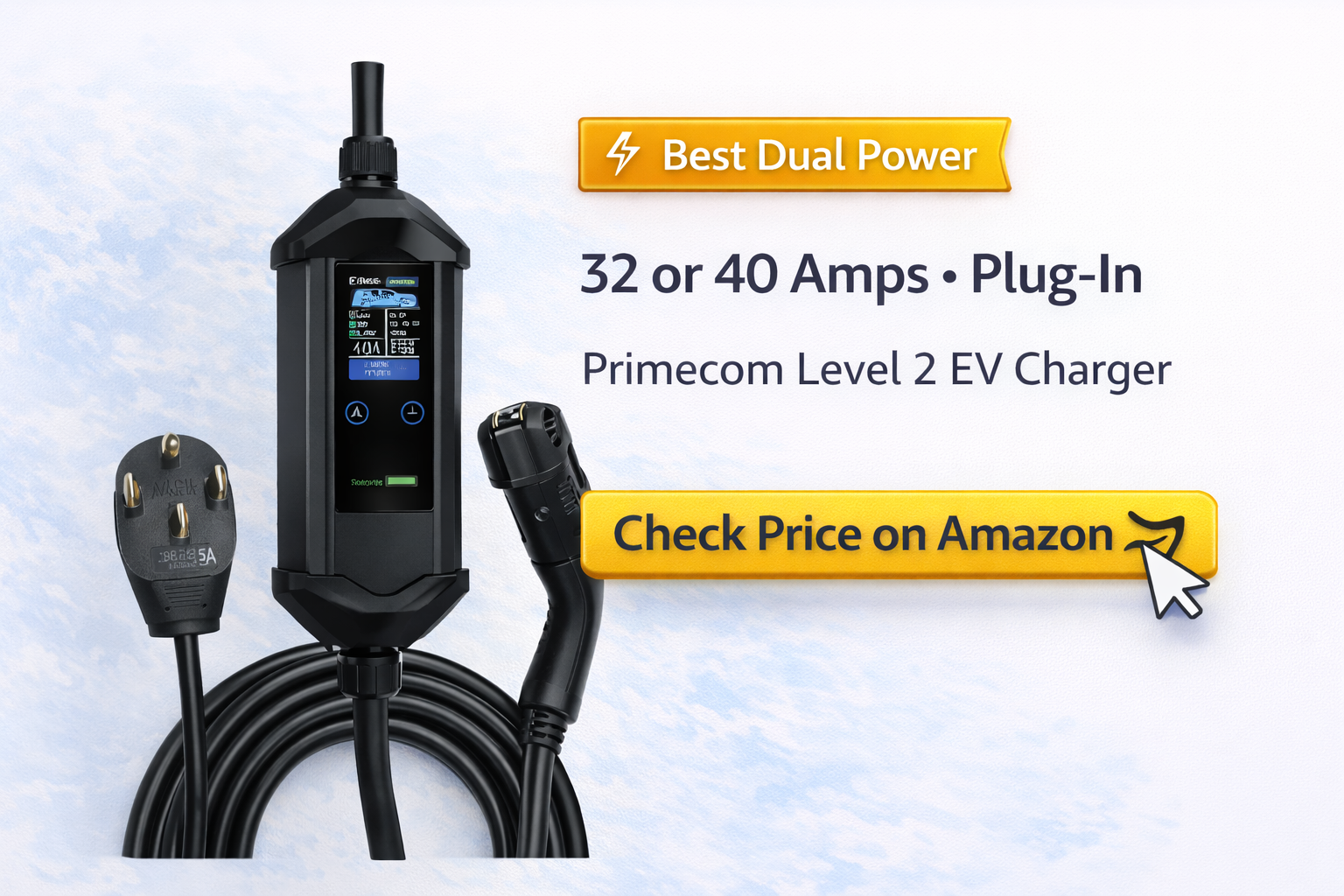
The Primecom Level 2 EV Charger is one of the most versatile and cost-effective home charging solutions available in 2026. Designed for drivers who want flexibility without sacrificing reliability, this charger supports both 32 amp and 40 amp plug-in charging, making it ideal for a wide range of electric vehicles and home electrical setups.
With a NEMA 14-50 plug, installation is fast and simple — no hardwiring required. The included SAE J1772 connector ensures full compatibility with all EVs and PHEVs sold in North America, including Tesla vehicles when used with an adapter.
- ✔ Dual power options: 32A or 40A Level 2 charging
- ✔ Plug-in NEMA 14-50 for easy installation
- ✔ J1772 connector compatible with all North American EVs
- ✔ Multiple cable length options (up to 50 ft)
- ✔ Ideal balance between performance and price
This charger is perfect for homeowners who want a reliable overnight charging solution without the cost and complexity of high-power hardwired systems. It delivers significantly faster charging than Level 1 outlets while remaining affordable and easy to use.
Primecom Level 2 EV Charger – Flexible Plug-In Charging with Excellent Cost-Benefit
The Primecom Level 2 EV Charger is designed for electric vehicle owners who want a reliable, fast, and flexible home charging solution without the complexity or higher installation costs associated with hardwired systems. Positioned as one of the best plug-in Level 2 chargers on the market, Primecom offers a strong balance between performance, usability, and affordability.
This charger is especially popular among homeowners, renters, and EV drivers who want an easy-to-install solution that still delivers significantly faster charging than a standard household outlet. With support for 32A and 40A charging configurations, it meets the needs of most daily EV users while keeping overall costs under control.
Plug-In Convenience with Level 2 Performance
One of the standout advantages of the Primecom Level 2 charger is its NEMA 14-50 plug-in design. Unlike hardwired chargers, this unit can be connected to a compatible 240V outlet, making installation faster, simpler, and more affordable. For many users, this eliminates the need for extensive electrical upgrades.
Despite its plug-in nature, the Primecom charger still delivers true Level 2 performance, providing up to 40 amps of charging power. This allows most electric vehicles to gain approximately 25–30 miles of range per hour, depending on the vehicle’s onboard charger and battery size.
For drivers with average daily commutes, this means a full overnight recharge is easily achievable, even after longer trips. Compared to Level 1 charging, the improvement in speed and convenience is immediately noticeable.
Flexible Cable Length Options and Practical Design
Primecom offers this Level 2 charger with multiple cable length options, including extended cables of up to 50 feet. This flexibility is a major benefit for garages with unconventional layouts or driveways where vehicles may not always park in the same position.
The charger’s cable is rugged yet flexible, making it easy to handle in both indoor and outdoor environments. Integrated cable management helps keep the charging area organized and reduces wear over time.
A built-in digital display provides clear, real-time charging information, such as current output and charging status. This feature is particularly useful for users who prefer immediate visual feedback without relying on smartphone apps.
Universal Compatibility for Most EVs
The Primecom Level 2 charger uses a standard SAE J1772 connector, ensuring compatibility with nearly all electric vehicles and plug-in hybrids sold in North America. Tesla vehicles are fully supported when used with a standard J1772-to-NACS adapter.
This universal compatibility makes the charger a safe choice for households that may switch EV brands in the future or own multiple electric vehicles from different manufacturers.
Safety Certifications and Everyday Reliability
Safety is a critical factor for any home charging solution, and the Primecom charger meets essential industry standards. It is designed with built-in protection against overcurrent, overheating, and electrical faults, helping ensure safe daily operation.
The enclosure is built to handle both indoor and outdoor use, offering resistance to dust, moisture, and temperature variations. While it may not feature the heavy-duty enclosure of commercial-grade chargers, it provides more than enough durability for typical residential environments.
Cost-Benefit Advantage Compared to Hardwired Chargers
One of the strongest arguments in favor of the Primecom Level 2 charger is its excellent cost-benefit ratio. By avoiding hardwired installation, users can save significantly on electrician labor and electrical upgrades, reducing the total cost of ownership.
While it does not offer advanced smart features like Wi-Fi connectivity or energy tracking apps, many EV owners find that the simplicity of a plug-in charger meets their needs perfectly. The charger focuses on delivering consistent power without unnecessary complexity.
For users who value flexibility, portability, and straightforward operation, this approach can be more appealing than app-dependent smart chargers.
Who the Primecom Level 2 Charger Is Best For
The Primecom Level 2 EV charger is an ideal choice for:
- Homeowners who want Level 2 charging without hardwired installation
- Renters who need a charger that can be easily unplugged and relocated
- EV owners looking for strong performance at a reasonable price
- Drivers who prefer simple, reliable operation over advanced smart features
While premium chargers may offer higher amperage or app-based controls, the Primecom charger stands out as one of the most practical and accessible Level 2 options available today.
Overall Value and Final Thoughts
The Primecom Level 2 EV Charger delivers exactly what many EV owners are looking for: fast home charging, flexible installation, and dependable performance at a competitive price. It bridges the gap between basic entry-level chargers and more expensive high-end models.
For drivers who want a reliable plug-in solution that offers exce
The Tesla Universal Wall Connector is the best Level 2 home EV charger for Tesla owners, offering fast charging, sleek design, and universal compatibility. With dual plug support (NACS and J1772), it works seamlessly with Tesla and non-Tesla electric vehicles across North America.
Designed by Tesla, this charger delivers up to 44 miles of range per hour, making it ideal for overnight charging and daily commuting. Its minimalist design blends perfectly with modern garages while offering professional-grade reliability.
The Tesla Universal Wall Connector is the most refined and seamless home charging solution
available for Tesla owners who want a charger designed by the same brand that built their vehicle.
Engineered specifically for Tesla’s ecosystem, this Level 2 EV charger combines elegant design,
high reliability, and native compatibility with Tesla vehicles.
Unlike third-party chargers, the Tesla Universal Wall Connector integrates perfectly with Tesla vehicles,
delivering a smooth charging experience that requires minimal configuration. It is an ideal choice for
drivers who value simplicity, consistency, and brand-native performance.
The Tesla Universal Wall Connector delivers up to 48 amps of Level 2 charging power,
providing fast and efficient home charging for most Tesla models. Depending on the vehicle and electrical
setup, this translates to approximately 44 miles of range per hour, making overnight
charging fast and dependable.
This performance level is well-suited for daily driving needs, long commutes, and frequent road trips.
Tesla vehicles are designed to communicate seamlessly with the Wall Connector, automatically adjusting
charging rates for optimal battery health and efficiency.
While it does not reach the extreme amperage levels of some high-power third-party chargers, the Tesla
Wall Connector strikes an excellent balance between speed, safety, and long-term battery care.
One of the most important upgrades in the Tesla Universal Wall Connector is its
dual-connector compatibility. It supports both NACS (Tesla) and
J1772, making it a future-proof solution as North America transitions toward Tesla’s
charging standard.
This means the charger can be used not only with Tesla vehicles but also with other EVs that rely on
the J1772 connector. For households with mixed EV brands or those planning to switch vehicles in the
future, this flexibility adds significant long-term value.
Tesla is known for its minimalist design philosophy, and the Universal Wall Connector reflects that
aesthetic perfectly. The slim, modern profile blends seamlessly into garages, carports, and exterior
walls, enhancing rather than detracting from the home’s appearance.
The charger is rated for both indoor and outdoor installation, with a durable,
weather-resistant enclosure capable of handling rain, dust, snow, and temperature extremes. This makes
it suitable for a wide range of climates and installation environments.
A built-in cable management system keeps the charging cable neatly stored when not in use, reducing wear
and maintaining a clean, organized charging area.
The Tesla Universal Wall Connector includes Wi-Fi connectivity for firmware updates and
system monitoring. While it does not rely on a traditional mobile app like some smart chargers, Tesla
vehicles handle most charging management directly through the vehicle’s interface and Tesla mobile app.
One standout feature is power sharing, which allows multiple Tesla Wall Connectors to be
installed on a single electrical circuit. This is particularly useful for households with more than one
Tesla, as it intelligently distributes available power between vehicles.
This feature can significantly reduce electrical upgrade costs while still allowing multiple vehicles to
charge efficiently.
Safety is a core focus of Tesla’s charging hardware. The Universal Wall Connector is built to meet strict
safety standards and includes multiple layers of protection against overcurrent, overheating, and
electrical faults.
Because Tesla controls both the vehicle and the charger, communication between the two systems is highly
optimized. This reduces the risk of compatibility issues and ensures consistent performance over the
lifespan of the charger.
The Tesla Universal Wall Connector is a hardwired Level 2 charger and requires professional
installation by a licensed electrician. Installation costs vary depending on the home’s electrical
infrastructure, but the process is generally straightforward.
Tesla provides clear installation documentation, and many electricians are already familiar with Tesla
charging equipment, which can help streamline the setup process.
This charger is best suited for:
While third-party chargers may offer higher amperage or more advanced standalone apps, the Tesla Universal
Wall Connector excels in integration, reliability, and user experience for Tesla drivers.
The Tesla Universal Wall Connector delivers a premium charging experience tailored specifically to Tesla
vehicles. Its combination of reliable Level 2 performance, elegant design, and future-proof compatibility
makes it one of the best home charging investments for Tesla owners.
For drivers who want a charger that feels like a natural extension of their Tesla, this Wall Connector
remains the top choice in its category.
The EVIQO Level 2 Smart EV Charger is the ideal choice for drivers who want intelligent charging,
real-time monitoring, and a clean modern design. With built-in Wi-Fi connectivity and app control,
this charger lets you manage charging sessions, track energy usage, and optimize charging schedules
directly from your smartphone.
This smart charger is perfect for homeowners who want convenience, control, and peace of mind.
Its compact footprint, intuitive app, and strong safety certifications make it one of the
best value smart EV chargers in 2026.
The EVIQO Level 2 Smart EV Charger is designed for electric vehicle owners who want modern
smart charging features without paying the premium prices often associated with high-end EV chargers.
Positioned as one of the best value smart chargers available, EVIQO delivers a strong combination of
performance, connectivity, safety, and ease of installation.
With a charging capacity of up to 40 amps (9.6 kW), this Level 2 charger is capable of
fully recharging most electric vehicles overnight, making it an excellent choice for daily home use.
It is especially attractive for homeowners who want app-based control and energy monitoring at a
reasonable price point.
The EVIQO charger provides true Level 2 charging performance, delivering significantly faster charging
speeds than a standard Level 1 outlet. At 40 amps, most EVs can gain approximately
25 to 35 miles of range per hour, depending on the vehicle’s onboard charger and battery
configuration.
This performance level is ideal for the majority of EV owners who drive daily and want the convenience
of waking up each morning to a fully charged vehicle. Whether charging overnight or between errands,
the EVIQO charger offers consistent and dependable power delivery.
One of the key advantages of the EVIQO Level 2 charger is its built-in Wi-Fi connectivity
and companion mobile app. Through the app, users can start or stop charging sessions remotely, schedule
charging during off-peak electricity hours, and monitor energy usage in real time.
These smart features allow homeowners to optimize charging behavior, potentially reducing electricity
costs while maintaining full control over their EV charging routine. For users who enjoy data insights
and remote management, the EVIQO app adds meaningful value without unnecessary complexity.
Unlike some smart chargers that rely heavily on cloud services, the EVIQO system is designed to remain
functional even if connectivity is temporarily interrupted, ensuring reliable charging at all times.
The EVIQO Level 2 charger features a NEMA 14-50 plug-in design, allowing it to be connected
to a compatible 240V outlet without hardwired installation. This significantly reduces installation
complexity and cost compared to permanently wired chargers.
For homeowners who already have a NEMA 14-50 outlet, installation can often be completed in minutes.
This makes the EVIQO charger an excellent option for users who want fast setup, renters who may relocate,
or homeowners who want flexibility for future changes.
Despite its plug-in design, the charger maintains strong electrical stability and is suitable for
long-term daily use in residential environments.
The EVIQO charger uses a standard SAE J1772 connector, making it compatible with all
electric vehicles and plug-in hybrids sold in North America. Tesla vehicles are fully supported when
paired with a J1772-to-NACS adapter.
This universal compatibility ensures that the charger remains useful even if you switch vehicle brands
in the future, adding to its long-term value.
Safety is a critical aspect of home EV charging, and the EVIQO Level 2 charger meets essential industry
standards. It is UL and ETL certified and includes built-in protection against
overcurrent, overheating, and electrical faults.
The enclosure is designed for both indoor and outdoor use, offering protection against dust, moisture,
and everyday environmental exposure. Combined with a durable 25-foot charging cable,
the charger provides both reach and resilience for typical residential installations.
One of the strongest selling points of the EVIQO Level 2 Smart EV Charger is its
excellent price-to-feature ratio. While premium smart chargers may offer higher amperage
or commercial-grade components, many homeowners simply do not need that level of power.
The EVIQO charger focuses on delivering the features that matter most for everyday use: reliable Level 2
charging, smart scheduling, energy monitoring, and simple installation. For many users, this results in
a better overall value than more expensive alternatives.
The EVIQO Level 2 Smart EV Charger is an excellent choice for:
The EVIQO Level 2 Smart EV Charger offers a compelling balance of performance, intelligence, and
affordability. It delivers the essential benefits of smart EV charging without unnecessary cost or
complexity, making it one of the most attractive value options in the Level 2 category.
For EV owners who want a modern, app-enabled home charging solution that is easy to install and built
for everyday reliability, the EVIQO charger stands out as a smart investment.
As electric vehicles become more popular every year, one question consistently appears at the top of Google searches:
“Is a Level 2 EV home charger worth it?”
In 2026, the answer is clearer than ever — for most EV owners, a Level 2 charger is no longer a luxury, but a practical necessity.
This final guide was created to answer the most searched questions about Level 2 EV chargers, explain how they work,
who should install one, how much they cost, and how to choose the best option for your home.
Whether you are buying your first electric vehicle or upgrading your charging setup, this guide will help you make a confident decision.
A Level 2 EV charger is a 240-volt electric vehicle charging station designed for residential or commercial use.
It delivers significantly more power than a standard Level 1 charger, which typically plugs into a regular 120-volt wall outlet.
While most electric cars include a basic Level 1 charger, these are intentionally slow.
A Level 2 charger operates at higher voltage and amperage, allowing it to deliver
up to 10–14 times faster charging speeds, depending on the model and electrical installation.
In practical terms, this means:
For modern EVs with larger batteries, Level 2 charging transforms the ownership experience.
Instead of planning around charging time, charging becomes automatic, predictable, and stress-free.
One of the most common Google searches is:
“What’s the difference between Level 1 and Level 2 EV chargers?”
The difference comes down to speed, convenience, and long-term usability.
Level 1 chargers are suitable only for light use — short daily drives, plug-in hybrids, or emergency charging.
For full electric vehicles, especially those driven daily, Level 1 charging often becomes a bottleneck.
Level 2 chargers, on the other hand, are designed for real-world driving habits.
They allow you to fully recharge overnight, even after long commutes or road trips.
For many EV owners, the upgrade to Level 2 is the moment when owning an electric vehicle finally feels effortless.
In 2026, the question is less “Is it worth it?” and more “Why wait?”
Battery capacities are increasing, charging infrastructure is expanding, and electricity pricing is becoming more dynamic.
Level 2 chargers integrate better with smart grids, time-of-use electricity plans, and renewable energy sources like solar panels.
Homeowners who install Level 2 chargers often report:
For households with more than one EV, a Level 2 charger is almost mandatory.
Even a single charger can easily support multiple vehicles with scheduled charging.
Charging speed is one of the most searched topics related to EV chargers.
The exact speed depends on three main factors:
A 40-amp Level 2 charger typically delivers around 9.6 kW, while an 80-amp charger can deliver up to 19.2 kW.
However, the vehicle itself may limit how much power it can accept.
Even when limited by the vehicle, Level 2 charging remains dramatically faster than Level 1.
For most drivers, this means going from nearly empty to fully charged overnight.
Another frequent Google question is:
“Is a Level 2 EV charger safe to use at home?”
The answer is yes — when properly installed.
Modern Level 2 chargers are built with multiple layers of safety:
Most manufacturers strongly recommend professional installation, especially for high-amperage hardwired chargers.
This ensures compliance with electrical codes and long-term reliability.
Once installed correctly, Level 2 chargers are designed to operate safely every day — including overnight charging.
A Level 2 charger is ideal for:
Even casual EV drivers often discover that Level 2 charging quickly becomes indispensable.
The convenience alone often justifies the investment within the first few months of ownership.
In the next section, we’ll explore installation requirements, electrical upgrades, and real-world costs,
answering some of the most common pricing and setup questions searched on Google.
One of the most common concerns EV owners have before purchasing a Level 2 charger is installation.
Searches like “How much does it cost to install a Level 2 EV charger?” and
“Do I need to upgrade my electrical panel?” appear thousands of times every month.
The good news is that installing a Level 2 EV charger in 2026 is more straightforward than many people expect.
However, costs and complexity vary depending on your home’s electrical system, the charger type,
and local regulations.
In almost all cases, the answer is yes.
While some plug-in Level 2 chargers may appear simple to install, professional installation is strongly recommended,
especially for chargers rated above 32 amps.
A licensed electrician ensures:
Many manufacturers explicitly require professional installation to maintain warranty coverage,
particularly for hardwired Level 2 chargers.
A Level 2 charger operates on a 240-volt circuit, similar to electric dryers or ovens.
The required amperage depends on the charger’s power rating.
Typical requirements include:
The electrician will also verify that your electrical panel has enough available capacity
to support the new circuit safely.
This is one of the most searched questions related to EV chargers:
“Do I need to upgrade my electrical panel for a Level 2 charger?”
The answer depends on three factors:
Many modern homes with 200-amp panels can install a Level 2 charger without upgrades.
Older homes with 100-amp panels may require a panel upgrade, especially for high-power chargers.
Some smart chargers can dynamically adjust charging speed based on household usage,
allowing installation without a full panel upgrade.
This feature can significantly reduce upfront costs.
Level 2 chargers come in two main installation types:
hardwired and plug-in.
Hardwired chargers are directly connected to your electrical system.
They typically support higher amperage and offer greater reliability.
Advantages include:
These are ideal for high-performance chargers (48A–80A) and permanent installations.
Plug-in chargers connect to a NEMA outlet (commonly NEMA 14-50).
They offer flexibility and portability.
Advantages include:
However, plug-in chargers are usually limited to lower amperage
and may require outlet inspection over time.
Installation costs vary by region and home layout, but average estimates in 2026 are:
These costs often decrease when combined with rebates, incentives, or tax credits.
In many jurisdictions, installing a Level 2 EV charger requires:
While this may sound inconvenient, permits ensure safety and protect homeowners
from insurance or resale issues later.
Most licensed electricians handle the permit process as part of the installation package.
One of the most overlooked aspects of EV charger installation is financial incentives.
Many Level 2 chargers qualify for:
These incentives can significantly reduce both equipment and installation costs.
In some regions, homeowners recover up to 30–50% of the total expense.
Avoiding these common mistakes can save money and prevent safety issues:
Planning for the future is especially important as EV battery sizes continue to increase.
Most Level 2 EV charger installations are completed within:
In most cases, homeowners can begin charging the same day.
For most EV owners, installation costs are quickly offset by:
In the next section, we’ll compare hardwired vs plug-in chargers in depth,
helping you decide which option delivers the best long-term value for your home.
One of the most common and important decisions EV owners face when choosing a Level 2 charger is whether
to install a hardwired EV charger or a plug-in EV charger.
Google searches such as “hardwired vs plug-in EV charger”,
“Is a hardwired EV charger better?”, and
“Can I plug in a Level 2 charger?” reflect how confusing this choice can be.
Both options deliver true Level 2 charging, but they differ significantly in installation, power capacity,
flexibility, safety considerations, and long-term value. Understanding these differences is essential
to choosing the right charger for your home and driving habits.
A hardwired Level 2 EV charger is permanently connected to your home’s electrical system.
It does not plug into an outlet. Instead, it is wired directly into a dedicated 240-volt circuit by
a licensed electrician.
Hardwired chargers are commonly used for higher-power installations and are considered the most
robust and reliable option for long-term home charging.
Because there is no plug or receptacle involved, hardwired chargers minimize one of the most common
failure points in high-power charging setups. This makes them ideal for daily charging, multiple EV
households, and long-term ownership.
A plug-in Level 2 EV charger connects to a 240-volt outlet, most commonly a
NEMA 14-50 receptacle. This is similar to how electric ranges or RV hookups are powered.
Plug-in chargers are popular because they offer flexibility and often lower upfront installation costs.
Many homeowners already have a compatible outlet, which can simplify setup significantly.
Plug-in chargers are typically limited to lower amperage levels, but for many EV owners,
this is more than sufficient for overnight charging.
One of the most searched questions is:
“Is a hardwired EV charger faster than a plug-in charger?”
The answer depends on amperage.
Plug-in chargers are usually limited to 32A or 40A, while hardwired chargers
can support 48A, 64A, or even 80A. Higher amperage means more power and faster charging,
assuming your vehicle can accept it.
For example:
However, many EVs are limited by their onboard chargers and cannot take advantage of extremely high power.
In those cases, the real-world difference between a 40A and 48A charger may be minimal.
Safety is a major concern for EV owners, and it frequently appears in searches like
“Are plug-in EV chargers safe?” and
“Is hardwired EV charging safer?”.
Both options are safe when installed correctly, but there are important differences.
Hardwired chargers are often recommended for higher amperage because they eliminate
the risk of loose plugs or worn receptacles.
Using an industrial-grade NEMA 14-50 outlet installed by a professional electrician
greatly reduces risks associated with plug-in charging.
Cost is often the deciding factor for many buyers.
Typical cost differences include:
These figures assume no major electrical panel upgrades.
High-amperage hardwired chargers may increase costs if additional capacity is required.
While plug-in chargers are generally cheaper to install, hardwired chargers may offer
better long-term value due to durability and higher power capability.
Plug-in chargers offer greater flexibility. They can be unplugged and moved if you relocate,
making them ideal for renters or short-term homeowners.
Hardwired chargers, while less portable, are often more future-proof.
As EV batteries continue to grow and charging demands increase,
higher-power hardwired systems are better positioned to meet future needs.
The best choice depends on your situation:
Many EV owners start with a plug-in charger and later upgrade to hardwired as their needs grow.
Others install hardwired chargers from day one to avoid future changes.
Understanding both options fully helps avoid unnecessary costs and ensures a safer,
more satisfying charging experience.
In the next section, we’ll explore smart charging features, Wi-Fi apps,
solar integration, and future-proofing strategies that many EV owners
now consider essential.
As electric vehicles evolve, charging is no longer just about plugging in and waiting.
One of the fastest-growing areas of interest in Google searches is
smart EV charging.
Queries such as “What is a smart EV charger?”,
“Do I need Wi-Fi for my EV charger?”,
and “Can I use solar panels with a Level 2 charger?”
reflect how important intelligent charging has become for modern EV owners.
In 2026, smart charging is not just a convenience feature.
It plays a key role in reducing electricity costs, managing home energy usage,
integrating renewable energy, and preparing for the future of electric mobility.
A smart Level 2 EV charger is a charging station that includes
connectivity features, typically Wi-Fi or Ethernet,
and is controlled through a mobile app or web interface.
Unlike basic chargers that simply deliver power,
smart chargers allow users to monitor, schedule, and optimize charging behavior.
Core smart charging features usually include:
These features are especially valuable in regions where electricity prices vary
throughout the day or where utilities offer incentives for off-peak charging.
A very common question is:
“Does an EV charger need Wi-Fi to work?”
The answer is no — but Wi-Fi significantly expands functionality.
Most smart chargers will still deliver power even if Wi-Fi is temporarily unavailable.
However, without connectivity, features like scheduling, energy tracking,
and remote control may be limited or unavailable.
For users who want basic overnight charging, Wi-Fi is optional.
For users who want to optimize costs, integrate solar, or manage multiple vehicles,
Wi-Fi-enabled chargers offer clear advantages.
One of the biggest financial benefits of smart EV charging is the ability to
take advantage of time-of-use (TOU) electricity rates.
Many utility companies charge less for electricity during off-peak hours,
typically late at night or early morning.
Smart chargers allow users to schedule charging automatically during these low-cost periods.
Instead of remembering to plug in at a specific time,
the charger handles everything in the background.
Over the course of a year, this can lead to substantial savings,
especially for drivers who charge frequently or have multiple EVs.
Another popular Google search is:
“How much electricity does my EV charger use?”
Smart chargers answer this question by providing detailed energy usage data,
often broken down by session, day, week, or month.
This information helps homeowners understand:
These insights are especially useful for households budgeting energy costs
or comparing home charging to public charging alternatives.
With the rise of residential solar installations,
many EV owners ask:
“Can I charge my EV with solar panels?”
The answer is yes — and smart chargers make this much easier.
While any EV charger can technically use solar-generated electricity,
smart chargers can intelligently align charging with solar production.
This allows homeowners to maximize self-consumption of renewable energy
instead of exporting excess power back to the grid.
Benefits of solar-integrated EV charging include:
Some advanced smart chargers can dynamically adjust charging speed
based on available solar output, ensuring efficient energy use throughout the day.
Load management is becoming one of the most important smart charging features.
Many homeowners worry about overloading their electrical panels when installing EV chargers.
Smart chargers with load-balancing capabilities can:
This technology is particularly valuable in older homes or multi-EV households,
where electrical capacity may be limited.
As multi-EV households become more common,
smart charging plays a critical role in managing multiple vehicles efficiently.
Features such as power sharing, user access control, and scheduled priority charging
allow families to charge more than one EV without upgrading electrical infrastructure.
This is one of the main reasons smart chargers are increasingly recommended
even for single-vehicle households planning to add a second EV in the future.
Another advantage of smart chargers is the ability to receive
over-the-air firmware updates.
These updates can improve performance, add features,
fix bugs, and enhance compatibility with new vehicles.
Choosing a charger from a reputable manufacturer with long-term software support
is an important part of future-proofing your investment.
A frequent question is:
“Do I really need a smart EV charger?”
The answer depends on your priorities.
Basic chargers offer simplicity and reliability,
while smart chargers offer control, optimization, and long-term flexibility.
For drivers with fixed schedules and flat electricity rates,
a basic charger may be sufficient.
For everyone else, smart charging provides tangible benefits that grow over time.
Future-proofing means choosing a charger that will remain useful
as EV technology evolves.
Key factors to consider include:
As EV adoption accelerates and energy systems become more interconnected,
smart charging will play an increasingly central role in home energy management.
In the final section, we’ll answer the most frequently asked questions,
highlight common mistakes to avoid,
and provide a final buying checklist to help you choose
the best Level 2 EV charger with confidence.
As Level 2 EV chargers become standard equipment for electric vehicle owners,
many questions repeatedly appear in Google searches.
This final section answers the most frequently asked questions,
highlights common mistakes to avoid,
and provides a clear checklist to help you choose the best Level 2 EV charger for your needs.
Yes. Almost all electric vehicles sold today are compatible with Level 2 charging.
In North America, most EVs use the J1772 connector,
while Tesla vehicles use the NACS connector.
Tesla owners can charge at J1772 stations using a simple adapter.
This universal compatibility is one of the reasons Level 2 chargers are considered
the most future-proof home charging solution.
This is a very common concern:
“Will Level 2 charging degrade my EV battery?”
The answer is no.
Level 2 charging operates well within the safe limits defined by EV manufacturers.
In fact, Level 2 charging is generally healthier for the battery than frequent DC fast charging.
Most EV manufacturers recommend Level 2 charging for daily use
because it balances speed, efficiency, and battery longevity.
Yes. Level 2 chargers are specifically designed for overnight charging.
Certified chargers include temperature monitoring, fault detection,
and automatic shut-off systems to ensure safe continuous operation.
Overnight charging is not only safe, but also cost-effective when paired
with time-of-use electricity rates.
Home charging costs depend on your electricity rate and vehicle efficiency.
On average, most EV owners spend significantly less charging at home
than fueling a gasoline vehicle.
Smart chargers make it easier to track and optimize these costs over time.
Yes. As EV adoption increases, homes with installed Level 2 chargers
are becoming more attractive to buyers.
A properly installed charger can be viewed as a future-ready upgrade,
similar to solar panels or smart home systems.
Avoiding these mistakes can save money and frustration:
A charger that is “too powerful” offers no benefit if your vehicle cannot use it.
Matching charger capacity to real needs is more important than chasing maximum specifications.
When selecting a Level 2 EV charger, consider the following factors carefully.
These criteria reflect what experienced EV owners and electricians prioritize most.
Choose a charger that matches both your vehicle’s onboard charger
and your home’s electrical capacity.
For most households, 40A or 48A chargers offer an excellent balance.
Decide between hardwired and plug-in based on permanence, cost,
and flexibility needs.
Smart chargers provide scheduling, monitoring, and energy optimization.
These features are especially valuable in regions with variable electricity rates.
Always choose chargers with recognized certifications such as UL, ETL, or CSA.
These ensure compliance with safety standards and insurance requirements.
A longer cable adds convenience and flexibility.
Look for rugged, weather-rated designs suitable for indoor and outdoor use.
Reputable manufacturers offer warranties ranging from 3 to 5 years
and provide accessible customer support.
Long-term support is a key indicator of product quality.
For most EV owners, the answer is a clear yes.
A Level 2 EV charger transforms charging from a limitation
into a seamless part of daily life.
With faster charging, lower costs, improved convenience,
and long-term flexibility, Level 2 home charging represents
one of the most valuable upgrades an EV owner can make.
By choosing the right charger, installing it correctly,
and leveraging smart features,
you can enjoy a charging setup that meets today’s needs
while remaining ready for the future of electric mobility.
Tesla Universal Wall Connector – Level 2 EV Charger
Tesla Universal Wall Connector – The Best Home EV Charger for Tesla Owners
Optimized Level 2 Charging Performance for Tesla Vehicles
Universal Compatibility and NACS Transition Ready
Elegant Design and Indoor/Outdoor Installation
Wi-Fi Connectivity and Power Sharing
Safety, Reliability, and Tesla Engineering
Installation Requirements and Considerations
Who the Tesla Universal Wall Connector Is Best For
Overall Value and Final Thoughts
EVIQO Level 2 Smart EV Charger (40 Amp)
EVIQO Level 2 Smart EV Charger – Smart Home Charging with Outstanding Value
Reliable Level 2 Performance for Everyday EV Charging
Smart Wi-Fi Connectivity and Mobile App Control
Simple Plug-In Installation and Flexible Setup
Universal Compatibility with J1772 Connector
Safety Certifications and Build Quality
Cost-Benefit Advantage Compared to Premium Smart Chargers
Who the EVIQO Level 2 Charger Is Best For
Overall Value and Final Thoughts
The Ultimate Guide to Level 2 EV Home Chargers (2026 Edition)
What Is a Level 2 EV Charger?
Level 1 vs Level 2 EV Charger: What’s the Real Difference?
Is a Level 2 EV Charger Worth It in 2026?
How Fast Is a Level 2 EV Charger?
Is Level 2 Charging Safe for Home Use?
Who Should Install a Level 2 EV Charger?
Level 2 EV Charger Installation: Costs, Electrical Requirements, and What to Expect
Do You Need a Professional Electrician?
Electrical Requirements for a Level 2 EV Charger
Do You Need an Electrical Panel Upgrade?
Hardwired vs Plug-In Installation
Hardwired Chargers
Plug-In Chargers
How Much Does It Cost to Install a Level 2 EV Charger?
Permits and Inspections: Are They Required?
Rebates, Incentives, and Tax Credits
Common Installation Mistakes to Avoid
How Long Does Installation Take?
Is Installation Worth the Investment?
Hardwired vs Plug-In Level 2 EV Chargers: Which One Is Right for Your Home?
What Is a Hardwired Level 2 EV Charger?
Key Advantages of Hardwired EV Chargers
What Is a Plug-In Level 2 EV Charger?
Key Advantages of Plug-In EV Chargers
Charging Speed: Does Hardwired Really Charge Faster?
Safety Considerations: Which Is Safer?
Hardwired Safety Benefits
Plug-In Safety Considerations
Installation Cost Comparison
Flexibility and Future Proofing
Which Option Is Better for Most Homeowners?
Common Mistakes When Choosing Between Hardwired and Plug-In
Smart EV Charging: Apps, Wi-Fi, Solar Integration, and How to Future-Proof Your Home
What Is a Smart Level 2 EV Charger?
Do You Need Wi-Fi for an EV Charger?
Time-of-Use Rates and Smart Scheduling
Energy Monitoring and Usage Insights
Solar Panel Integration and EV Charging
Load Management and Panel Optimization
Managing Multiple EVs with Smart Charging
Software Updates and Long-Term Support
Smart Chargers vs “Dumb” Chargers: Which Is Better?
Future-Proofing Your EV Charging Setup
Level 2 EV Chargers: FAQs, Common Mistakes, and the Ultimate Buying Checklist
Frequently Asked Questions About Level 2 EV Chargers
Can Any Electric Car Use a Level 2 Charger?
Does a Level 2 Charger Damage the Battery?
Can I Charge Overnight Every Day?
How Much Does It Cost to Charge an EV at Home?
Can a Level 2 Charger Increase Home Value?
Common Mistakes EV Owners Make When Buying a Level 2 Charger
How to Choose the Right Level 2 EV Charger
1. Charging Power
2. Installation Type
3. Smart Features
4. Safety Certifications
5. Cable Length and Build Quality
6. Warranty and Support
Final Buying Checklist
Final Thoughts: Is a Level 2 EV Charger Worth It?